Telco & Connectivity
Built for networks that cannot fail. kMetal enables telecom and connectivity providers to deliver carrier-grade infrastructure with the resilience, automation, and scale modern services demand.
kMETAL ENTERPRISE PLATFORM
kMetal is a Kubernetes management platform that turns infrastructure you already own into hyperscaler-grade compute capacity – cutting cost, eliminating hypervisor licensing, and letting teams operate their own layer at scale. For cloud, on-prem, bare metal, and sovereign infrastructure.
WHAT ORGANISATIONS ACHIEVE WITH kMETAL
98%
Reduction in control plane machines
>65%
Reduction in SRE operations
>90%
Reduction in depreciation cost
2 minutes
To provision a production-ready tenant cluster
THE BUSINESS CASE
Most Kubernetes environments become more expensive as clusters, teams, and workloads grow. kMetal removes three major sources of operational and infrastructure waste.
Every tenant cluster normally requires 3 dedicated machines for its control plane, doing almost nothing but overhead. For 30 clusters, that is 90 machines sitting largely idle.
kMetal consolidates Kubernetes control plane management onto shared infrastructure.
>50%
reduction in energy & facility costs
Traditional cluster architectures can require significantly more dedicated infrastructure as tenant environments scale, increasing hardware and lifecycle costs.
kMetal reduces the amount of infrastructure required to run tenant clusters at scale.
>90%
reduction in depreciation costs
As the fleet grows, provisioning, upgrades and management become harder to coordinate across a multi-cluster Kubernetes fleet, increasing DIY operational effort and costs.
kMetal provides one operational model for managing tenant clusters across the fleet.
>65%
reduction in SRE operations
kMetal tackles all three at once — on physical servers you already own.
BUSINESS IMPACT
kMetal doesn't just simplify Kubernetes operations. It changes how infrastructure scales across your organisation.
Run more environments on fewer machines while eliminating unnecessary control plane and hypervisor overhead.
Reduce infrastructure waste
Provision production-ready environments in seconds instead of waiting days or weeks for manual infrastructure requests.
Accelerate time to value
Free platform engineers from repetitive operational tasks so they can focus on strategic initiatives.
Do more without adding headcount
Add customers, workloads, and teams without operational complexity increasing at the same rate.
Scale without operational drag
THE PLATFORM
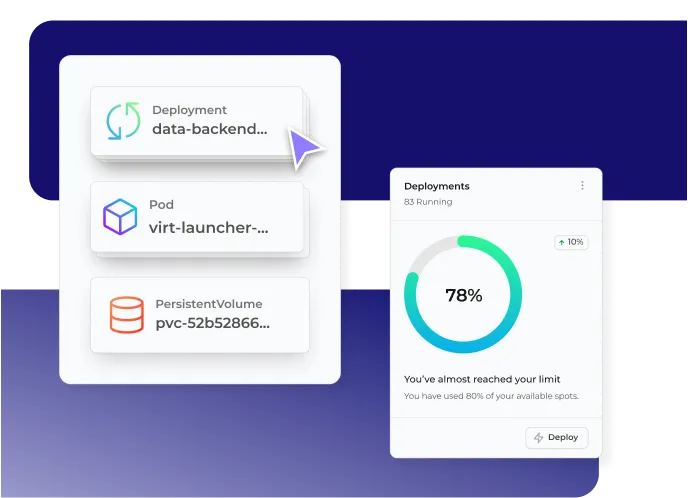
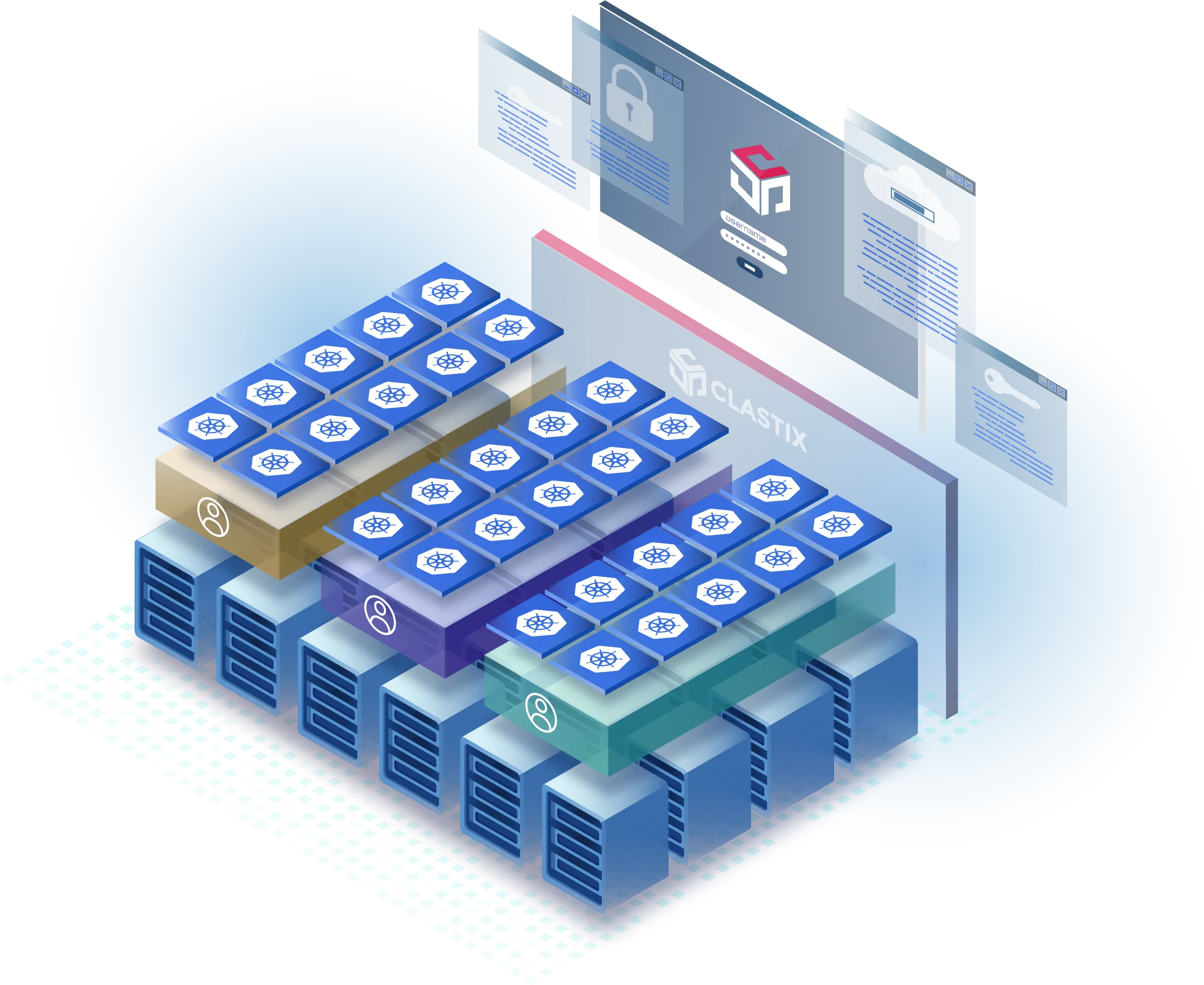
98% fewer control plane machines. No hypervisor licence. Multiple teams share infrastructure with complete isolation. The hardware bill and the licensing bill both shrink – without limiting what any team can do.
Teams provision their own Kubernetes environments in 2 min – without raising a ticket or waiting on a platform engineer. Self-service within administrator-defined guardrails. The bottleneck disappears.
Centralised access logging, audit trails, quota management, and monitoring across every tenant cluster – from one control point. One answer to every compliance, security, and spend question.
Bare metal Kubernetes on your own hardware, on-premises, fully under your control. No cloud provider account required. No vendor lock-in. No architectural decisions made on someone else's terms.
IN PRODUCTION
kMetal runs in production at organisations where scale, security, and reliability are non-negotiable. The demands of these environments shaped how the platform was built.
Built for networks that cannot fail. kMetal enables telecom and connectivity providers to deliver carrier-grade infrastructure with the resilience, automation, and scale modern services demand.
Purpose-built for the AI era. Kubernetes for AI infrastructure: share physical GPUs securely across isolated tenants to maximise utilisation, performance, efficiency, and reliability.
Trusted in environments where security, sovereignty, and resilience are non-negotiable.
Deliver managed Kubernetes and Kubernetes as a Service (KaaS) with speed, efficiency, and confidence. kMetal helps providers scale ops with enterprise-grade reliability.
INFRASTRUCTURE RESILIENCE · MADE IN ITALY WITH EUROPEAN SOVEREIGNTY
Independence shouldn't cost a premium – operating your own layer is cheaper than renting it. kMetal runs on infrastructure you own and control, with no hyperscaler dependency, no vendor lock-in, and no external governance over your data or workloads. The goal is practical: reduce uncontrollable dependencies, improve your ability to withstand disruption, and operate on your own terms.
EU Cloud Sovereignty Framework
EU Open Source Strategy
EU Cloud and AI Development Act
Your data. Your hardware. Your governance. No AWS ToS. Deploy on your infrastructure to reduce cloud dependency and retain control.
Run on any infrastructure. Switch providers. Federate environments. No architectural lock-in.
Open-source foundation, infrastructure independence, European company.
THE CLEAR CHOICE
kMetal combines infrastructure efficiency, operational consistency, and platform automation into a single Kubernetes operating model designed for long-term growth.
Reduce infrastructure costs
Provision environments in seconds
Scale without operational complexity
Eliminate hypervisor licensing overhead
Increase platform team productivity
Maintain control of infrastructure and governance
WHAT YOU GET
Every kMetal deployment includes Clastix Care from day one, SLA-backed support, direct engineer access, and monthly office hours. Not an add-on. Included.
FROM TECHNICAL CAPABILITIES TO BUSINESS IMPACT
Each capability is described twice: technically for the engineers who will operate it, and in plain language for the leaders who need to understand what changes for the organisation.
FOR THE TECHNICAL TEAM
If you are the engineer who will actually build on kMetal, or the technical leader validating the architecture, go deeper for everything you need know.
How kMetal's three layers work together, the management plane, hosted control planes via Kamaji, and KVM + OVN embedded isolation. Includes the full component diagram and how provisioning flows end-to-end.
Kamaji is the CNCF compliant project that powers kMetal's hosted control plane layer. Understand the relationship between the open-source building blocks and the production platform, including what kMetal adds on top.
How kernel-native KVM provides compute-level tenant isolation and OVN provides fully isolated tenant networking, without a separate hypervisor product. Performance characteristics and security model explained.
Cluster API, Terraform, Upbound APIs, GitOps workflows, and multi-provider configuration. How kMetal fits into the infrastructure and automation tooling your team already uses.
DEPLOY AND GO
COMMON QUESTIONS
Can’t find the answer you’re looking for? Check our full list of kMetal FAQs here.
No. Tenant worker nodes run as KubeVirt virtual machines on KVM, the hypervisor built into the Linux kernel, directly on bare metal. There is no nested virtualization and no separate hypervisor product to license.
No, and this is deliberate. The KVM layer in kMetal exists to provide kernel-level isolation for Kubernetes tenant clusters, not to run arbitrary Windows or Linux servers. A general-purpose hypervisor carries different requirements and expecting Virtual Machines to treat as pet, rather than cattle. kMetal is not positioned as a like-for-like VMware replacement for non-Kubernetes workloads.
Real ones. Each tenant cluster is upstream, CNCF-compliant Kubernetes with a dedicated control plane, a dedicated datastore, a dedicated kernel, a dedicated network domain, and full cluster-admin access for the tenant. Tenants can run different Kubernetes versions, different add-ons, and different policies. This is a different model from namespace-scoped virtual cluster products.
Three things you bring yourself. The primary CNI, because Kube-OVN runs as a secondary CNI and never takes over pod networking, so pod networking must already work before the operator starts. Storage, because kMetal ships no CSI driver, provisioner, StorageClass, or VolumeSnapshotClass. Credentials, because registry credentials and backup destinations are Secrets you create yourself.
Tenant worker nodes are KubeVirt virtual machines, so they can be given a real PCI device through passthrough or a mediated device such as a vGPU. Permitted devices are whitelisted in the kMetal resource and threaded through the ClusterClass. Node prerequisites are IOMMU enabled in firmware, the appropriate kernel parameter set, and the device bound to vfio-pci. Consumption is capped per tenant with a resource quota targeting the device resource name. GPUs are pinned per tenant cluster rather than per namespace.
Yes. kMetal v1.0.0 reached general availability on 31 August 2026, following a beta period. The product documentation and home page carry the v1.0 GA designation.
Talk to a Clastix commercial team member about your environment. We will map the current cost of your infrastructure setup, show you what consolidation looks like in practice, and give you the business case in plain language.
No commitment. 30-minute conversation.